




Quality & Compliance
Receiving & Reporting Suspected Adverse Reactions
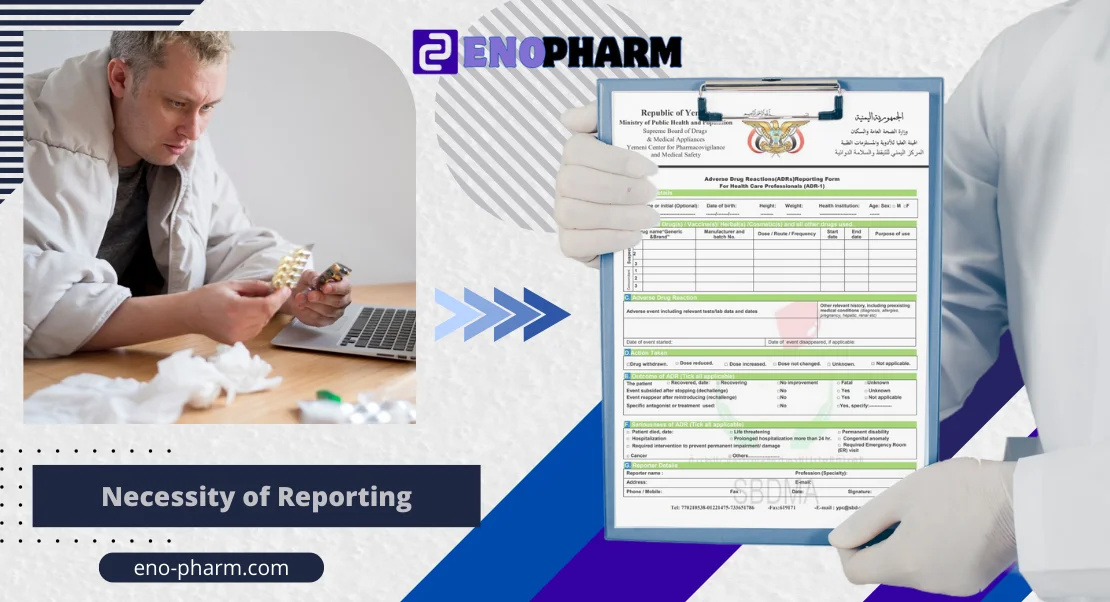
Enopharm Group receives reports of suspected adverse reactions linked to its products, handles the information received, and refers it to competent authorities under applicable requirements and procedures.

Our scope
Enopharm's role in medicine safety reporting
EnoPharm Group receives reports of suspected adverse reactions associated with products within its portfolio and handles the information for appropriate submission or referral to the competent authorities, in accordance with applicable requirements and procedures. This role does not replace the responsibilities or statutory functions of the national regulatory and pharmacovigilance authorities.
Assessment of pharmacovigilance information and all regulatory decisions and actions remain the mandate of authorized bodies. The group's role does not replace that of the national pharmacovigilance centre or regulatory authorities.
Scope of role
Receiving reports for the group's products • organizing information • reporting or referring to competent authorities
EnoPharm — reporting interface
- Receiving the report.
- Collecting the data.
- Organizing the information.
- Referring the report.
- Following up report-related requests within scope of responsibility.
Competent authorities
- National jurisdiction over pharmacovigilance and medicine safety.
- Assessment within statutory mandates.
- Official follow-up.
- Regulatory decisions and actions.
The group's role is limited to receiving reports linked to its products, organizing the information, and referring it. Scientific assessment and regulatory decisions belong to legally authorized bodies.
Pharmacovigilance emergencies
For urgent communication regarding drug-safety reports and cases that require immediate contact with the pharmacovigilance team, a phone line is available around the clock.
This number is dedicated to urgent pharmacovigilance and product-safety communication; it is not a substitute for requesting an ambulance or emergency medical care. In critical medical situations, go immediately to the nearest health facility or the competent emergency services.
Understanding reports
Suspected association does not prove causality
A suspected adverse event is any unexpected health problem appearing during or after product use. The timing between product use and a health event does not by itself prove a causal relationship — and the reporter is not required to prove medical causality to submit a report.
Product Use
Health Event
Report
Information Handling
Competent Authority
This sequence shows the path of information only; it does not decide that the product caused the event.
This site provides no individual diagnosis and does not determine the medical cause of symptoms.
What can be reported
General examples of product-linked information
When an event is linked to a product within the group's scope, available information can be reported — including non-serious cases.
- A health effect suspected of being linked to use.
- Additional information related to the event.
- A product suspected of being linked to the event.
- Product identification data where available.
- Extra information that helps understand the report.
No clinical classification is required to submit a report; available information is enough to begin.
How report handling works
Five clear stages
A general path for handling reports within the group's scope — with no fixed timelines and no claim of internal medical assessment.
Stage 01
Report Reception
Stage
Receiving the report through the dedicated form or email.
Elements
- Receiving the report through the dedicated form or email.
Outcome
Receiving the report through the dedicated form or email.
Protocol path
Stage
Receiving the report through the dedicated form or email.
Elements
- Receiving the report through the dedicated form or email.
Outcome
Receiving the report through the dedicated form or email.
Stage
Recording the information received and available about the report.
Elements
- Recording the information received and available about the report.
Outcome
Recording the information received and available about the report.
Stage
Reviewing the completeness of administrative information needed to identify the report and product — without claiming any medical assessment or causality determination.
Elements
- Reviewing the completeness of administrative information needed to identify the report and product — without claiming any medical assessment or causality determination.
Outcome
Reviewing the completeness of administrative information needed to identify the report and product — without claiming any medical assessment or causality determination.
Stage
Reporting or referring information to the competent authority per applicable regulatory requirements and procedures.
Elements
- Reporting or referring information to the competent authority per applicable regulatory requirements and procedures.
Outcome
Reporting or referring information to the competent authority per applicable regulatory requirements and procedures.
Stage
Following up on additional requests or inquiries about the report within the group's scope of responsibility.
Elements
- Following up on additional requests or inquiries about the report within the group's scope of responsibility.
Outcome
Following up on additional requests or inquiries about the report within the group's scope of responsibility.
No fixed response times are stated without confirmed official requirements.
No claim that every report undergoes internal medical assessment.
The group owns no national database.
No external pharmacovigilance signal assessment service is offered.
No advanced specialist pharmacovigilance systems or designations are attributed to the group unless approved documents prove their existence.
Scope of our role
What we do — what we do not provide
What we do
- Receive reports related to our products.
- Record the information received.
- Organize available report details.
- Report or refer information to competent authorities where required.
- Follow up relevant information within our scope.
What we do not provide
- Pharmacovigilance outsourcing for other companies.
- External PV system management.
- Independent medical diagnosis.
- National pharmacovigilance surveillance.
- Regulatory safety assessment or decision-making.
- A replacement for national competent authorities.
The boundaries above professionally describe the scope of work; scientific assessment and official decisions belong to legally authorized bodies.
Information that helps a report
What makes a report clearer?
- Product name.
- Patient name or initials, where appropriate and permitted.
- Description of the suspected event.
- Approximate date of the event.
- Reporter information.
- A contact method for clarifications.
- Other relevant available information.
Not all fields are mandatory — send what you have. Do not send highly sensitive medical files or unnecessary personal information.
This reporting form is not a substitute for medical advice or healthcare. In medical emergencies, seek immediate help from the appropriate medical services.
Parallel official channels
Reporting to national competent authorities
Professionals and patients may also report directly through official channels adopted by the Supreme Board of Drugs & Medical Appliances (SBDMA) and the national centre concerned, per established procedures. The Enopharm channel is not the only way to report.
Official authority links are published only after verifying they are current and official.
Privacy & emergency
- Collecting only the information needed to handle the report.
- Processing data per the Privacy Policy and applicable requirements.
- Reports are never used for marketing purposes.
- No medical advice is given through this site.
- Seek medical care immediately in emergencies.
Data is handled per established procedures and policies; no absolute confidentiality guarantee is offered beyond what approved policies provide.
Pharmacovigilance
Would you like to report a suspected adverse reaction?
If the report concerns a product within Enopharm Group's portfolio, you can use the dedicated reporting form or the approved report-reception channel.